
Read the article
here.Maya is a proposal strategist working on written deliverables that support WindBorne’s growth. Her academic background is in glaciology, and she previously worked in sustainability consulting and on Capitol Hill. In her free time, Maya enjoys being on or near the water, Miami Hurricanes football, and cooking.
Chloe is a content designer at WindBorne, crafting visuals and learning how the atmosphere and ocean work. Her work at WindBorne aims to distill the optimism that an emerging, global observation platform offers in the weather forecasting and science communities. In the spare moments, Chloe embarks on fruit-foraging walks with friends.
The constellation framing
WindBorne operates Atlas, the world’s largest balloon constellation. At any moment, Atlas comprises hundreds of long-duration high-altitude balloons called Global Sounding Balloons (GSBs), which traverse the stratosphere and troposphere, repeatedly collecting atmospheric data during their extended missions. Atlas has grown rapidly in the last several years. In September 2024, 14 GSBs were aloft; two years later, in September 2026, Atlas surpassed 700 concurrently aloft GSBs! At its current scale, WindBorne launches about 170 GSBs per week from more than a dozen permanent launch sites across the globe.
A traditional weather balloon carries a radiosonde that collects a single sounding—a snapshot of temperature, humidity, pressure, and wind as the balloon rises through the atmosphere. The GSBs that make up Atlas, on the other hand, remain aloft for weeks to months. While operational, they repeatedly ascend and descend between various altitudes, gathering atmospheric data in remote and often inaccessible regions. But unlike a radiosonde’s uninterrupted ascent, each GSB ascent–descent cycle may span a different segment and depth of the atmospheric column; one cycle might cover a few kilometers (km), and another might cover 10. As a constellation, multiple GSBs can collect vertical profiles across a given area of interest at a given point in time.
Put simply, one radiosonde collects one sounding, but one GSB can collect many soundings. So how does WindBorne quantify the volume of our constellation’s data? With a constellation-level unit called the sounding equivalent.
Tracking vertical distance
WindBorne tracks how much vertical distance each balloon travels. Because vertical distance is not a standard meteorological quantity, we convert it into a more familiar frame: the sounding equivalent, with 10 km of vertical distance equal to 1 sounding equivalent. Sounding equivalents are the base pricing unit for WindBorne’s Data-as-a-Service offerings. Critically, they measure the amount of data delivered, not which balloon delivered it.
Let’s say that three balloons collected data in an area of interest on a given day. Balloon A traveled a vertical distance of 58.4 km, Balloon B 46.1 km, and Balloon C 27.5 km. The aggregated vertical distance is 132 km, or 13.2 sounding equivalents. A customer receiving data for this area and day would receive 13.2 sounding equivalents of data. No single balloon in this example collected 13.2 sounding equivalents—the constellation did.
The figure below shows this at the constellation level. The 689 GSBs comprising the constellation during the seven-day period of September 3–10, 2026, collected over 9,000 soundings of various vertical distances (the color-coding of the dots). The total vertical distance traveled by all GSBs during this period amounted to 5,741 sounding equivalents.
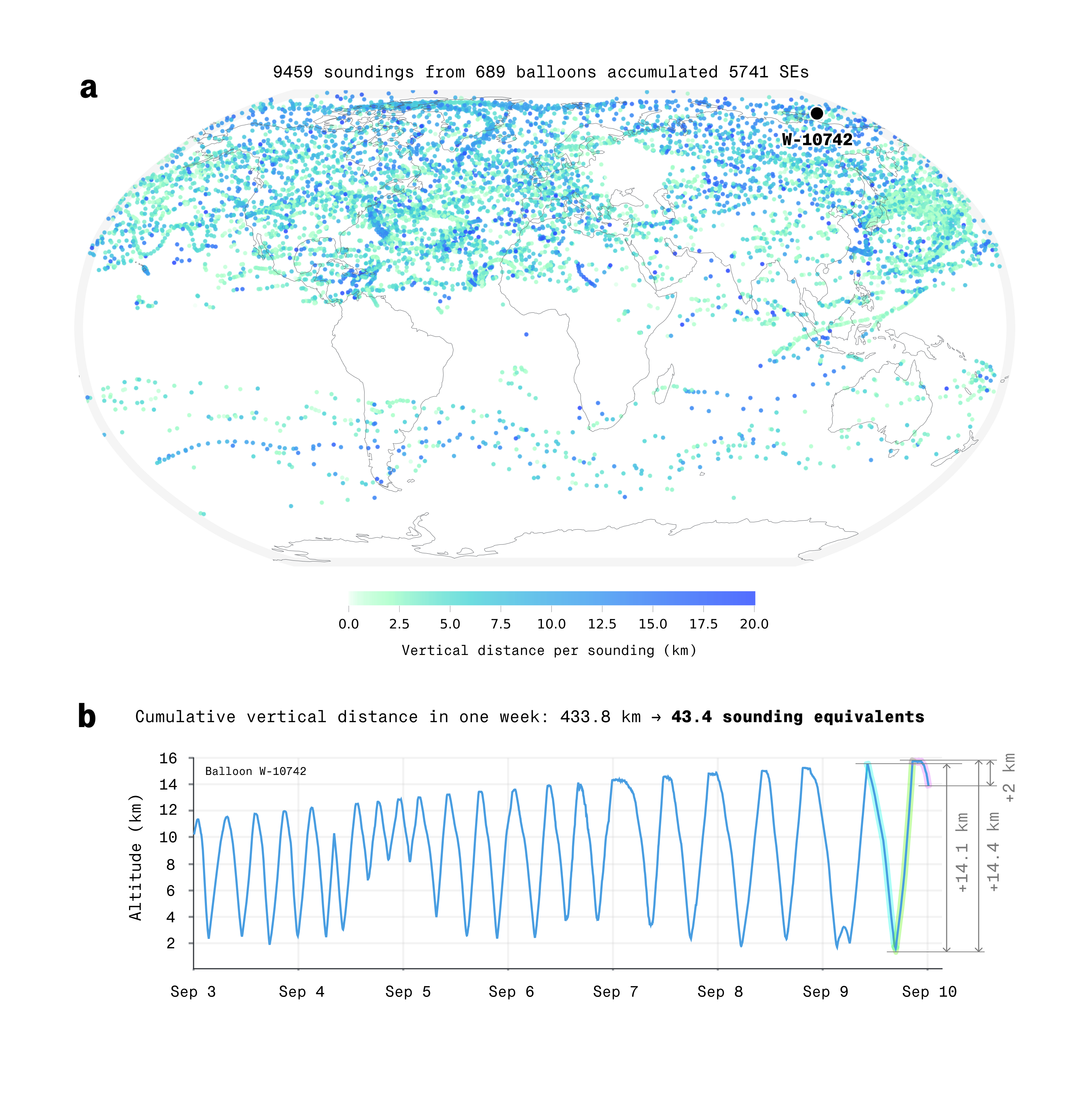
Sounding equivalents also apply at the individual GSB level—panel b shows one balloon traversing 433.8 km of vertical distance (43.4 sounding equivalents) over a single week. But the real power of the unit is at the constellation level. By aggregating sounding equivalents across balloons, customers get continuous data coverage and pay based on the amount of data delivered, not the number of balloons flown. Our customers can specify geographic, altitudinal, temporal, and other parameters for their data orders and receive all available constellation data that meets those requirements.
A week over the Pacific, as seen by Atlas
To make this more tangible, explore a single 10°×10° patch of atmosphere over the Pacific, where no balloons are regularly launched directly. Over just one week, Atlas made over 500,000 point observations within this area across 71 contributing balloons. They collected data over 2,666 km of vertical travel, or 266.6 sounding equivalents. Drag to rotate and zoom to view the patch from any angle as soundings accumulate through the week.
The bottom line
When you think about WindBorne data, picture the constellation: hundreds of GSBs ascending and descending across the globe, contributing to a stream of atmospheric observations. Sounding equivalents are how we measure how much data flows in that stream.


