

Read the article
here.The atmosphere doesn't stick to six-hour cycles. Your weather forecast shouldn't either.
Traditionally, global weather models run just four times a day, at 0z, 6z, 12z, and 18z (UTC). That means for most of the day, forecasts are already hours out of date. Although NOAA’s High Resolution Rapid Refresh (HRRR) model updates hourly, it only covers the U.S. and has a maximum horizon of 48 hours.
With WeatherMesh-5c, WindBorne introduces Continuous Forecasting, and the first continuously updated global weather model. WM-5c runs every 20 minutes, ingesting the latest observations—including a real-time stream of weather data from WindBorne's Global Sounding Balloons (GSBs)—to deliver forecasts that are always fresh and the most accurate. Instead of waiting six hours for the next update, WM-5c narrows the gap between what’s measured in the atmosphere and what’s reflected in the forecast down to 20 minutes.
What is Continuous Forecasting
How We Do It
- Lightweight architecture: WM-5c’s efficiency means a 24-member ensemble runs in parallel on 8 GPUs in just 16 minutes.
- Independent assimilation: Unlike other operational AI models, which depend on ECMWF or NOAA analyses published every 6 hours, WM-5c is powered by WindBorne’s proprietary AI-based data assimilation (AI DA) system. We use our own AI DA not only because it enables us to ingest balloon observations, but also because it results in better forecast accuracy than using ECWMF’s and NOAA’s analyses.
- Proprietary observations: Our balloon constellation collects more in-situ atmospheric data than the National Weather Service every day, feeding WM-5c with a unique source of information at minimal latency.
Continuous Forecasting vs Alternatives
- Earlier forecasts: WM-5c forecasts are available up to 6.5 hours before ECMWF’s.
- Fresher inputs: At any given time, WM-5c incorporates up to 8 hours more recent observations than ECWMF.
- Higher accuracy: At every forecast lead time, WM-5c outperforms ECMWF in accuracy.
- Resilient to external delays: With WM-5c’s own AI DA, it remains stable and fully operational even when ECMWF experiences delays or outages.
Example: Checking forecasts at 16:20 UTC
Just before European markets close at 16:30 UTC, the 12z run of ECMWF forecasts has not come out yet—the earliest forecast for the 12z cycle (step 0 of IFS HRES or AIFS-single, with pre-schedule delivery) won't become available until 17:05. The latest available ECMWF ensemble run is 6z (if forecasting within 6 days lead time), or 0z (if forecasting 7+ days ahead).
In contrast, the 16:00 run of WM-5c would have just become available moments ago, providing a 24-member ensemble forecasting out to 15 days.
About WM-5c
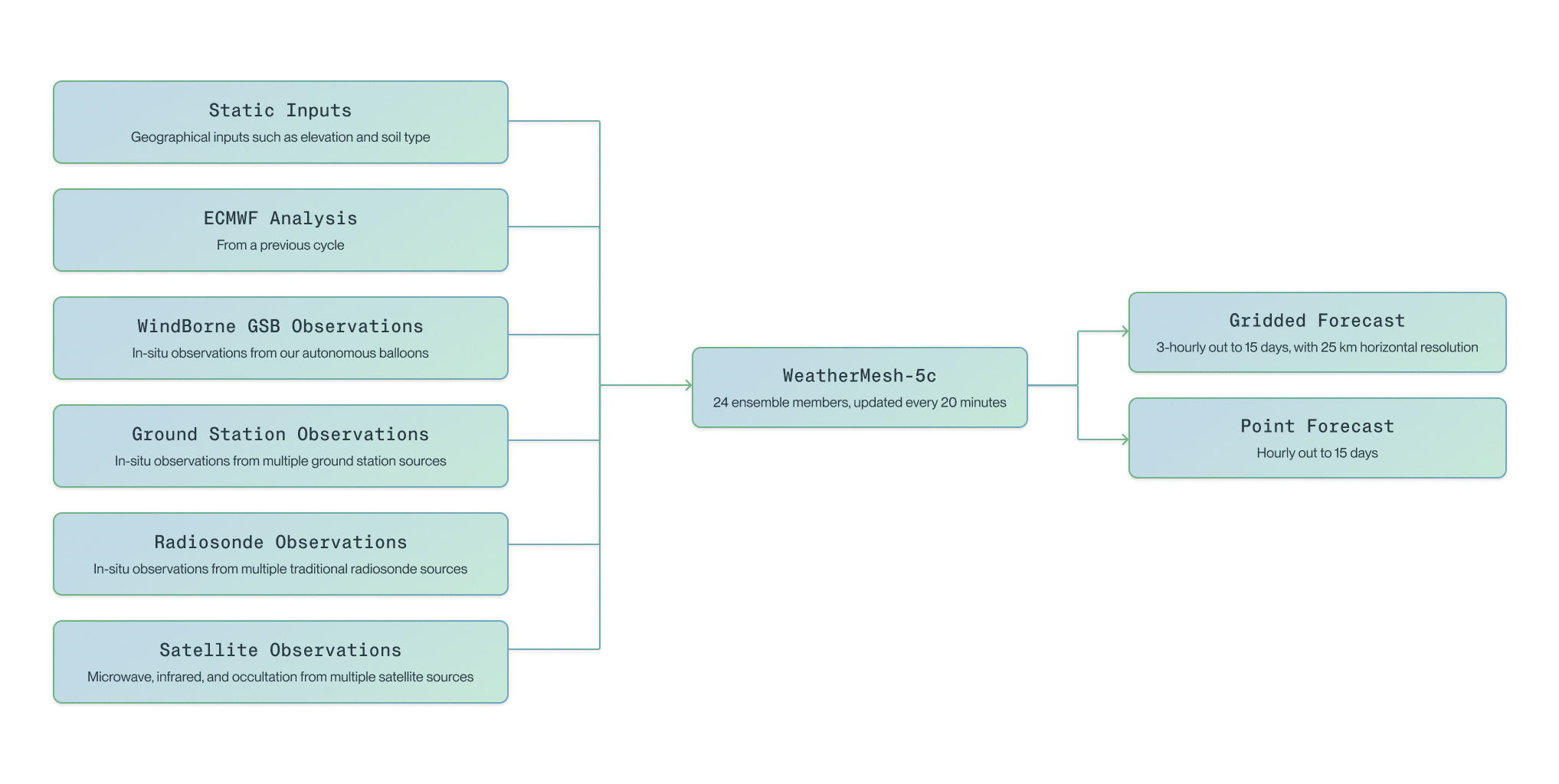
- Small but mighty: At 1/3 the size of our last generation of models, WM-5c delivers the same forecasting skill at a fraction of the compute cost. With further runtime optimizations, we are able to deliver a full-ensemble forecast every 20 minutes.
- Improved precipitation: Compared to WM-4, WM-5c has improved precipitation forecasts, both in terms of calibration and capturing extreme values.
- Improved wind speed: New 10-meter and 100-meter wind speed parameters deliver improved accuracy, especially for lead times over 7 days. For the full list of weather parameters available, our API documentation here will be updated for WM-5c on Dec 1 2025.
- Point forecasts:* WM-5c offers global gridded forecasts as well as point forecasts for key surface parameters such as temperature and wind.
- Diverse observational inputs: WM-5c incorporates observations from satellites, traditional radiosondes, ground weather stations, and WindBorne's own Global Sounding Balloons, fusing them with the ECMWF analysis from the previous cycle with WindBorne’s proprietary AI-based data assimilation system.
*Note: We currently only offer point forecasts for a pre-determined set of locations. If you are interested in point forecasts for your locations of interest, contact Karen Ye at karen@windbornesystems.com
Benchmarks
AI-Based Data Assimilation
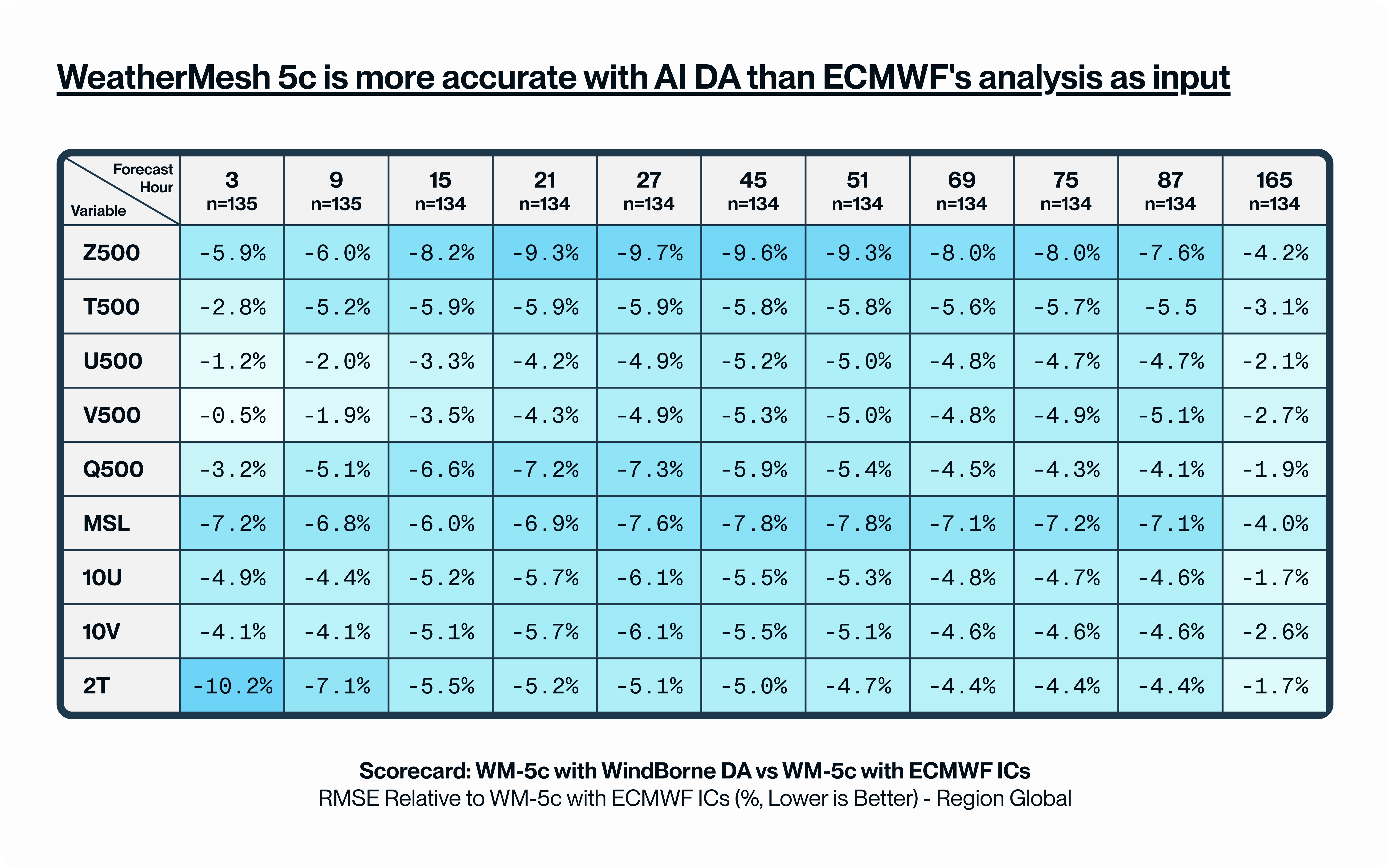
Our research on AI-based data assimilation (AI DA) has been essential to making WM-5c possible. Figure 1 compares the forecast accuracy of WM-5c when initialized with observational input using our own AI DA system against WM-5c initialized with standard ECMWF initial conditions. Across every variable and forecast lead time, WM-5c performs better when using our AI DA system. This explains why WM-5c can deliver more accurate forecasts long before ECMWF initial conditions are available—and why it remains robust even when ECMWF experiences a delay or outage.
Better Every Run
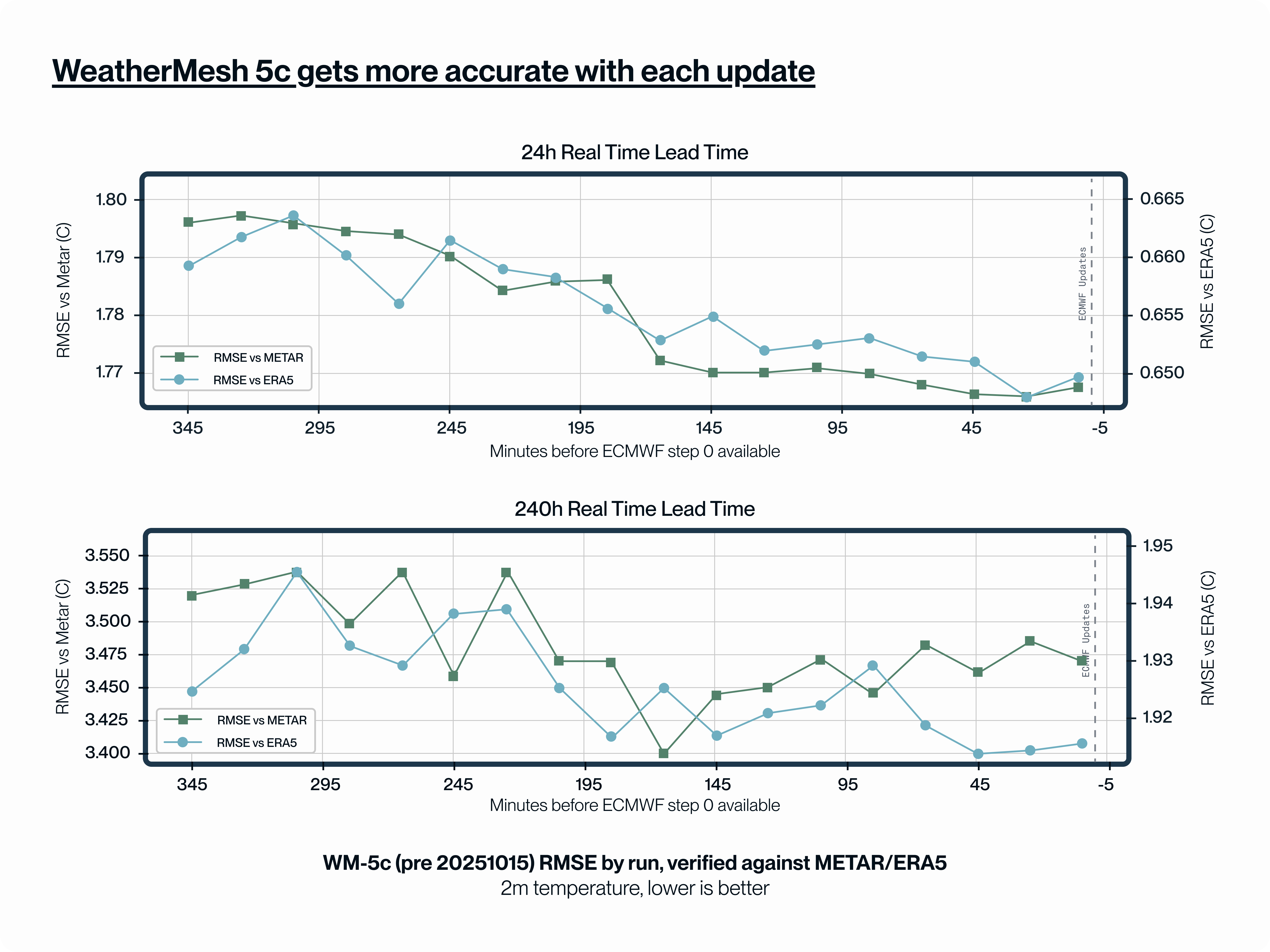
In the new regime of Continuous Forecasting, WM-5c provides 18 updates between every time ECMWF updates. A novel question that arises is: How does the forecast skill change with each incremental update? Figure 2 shows that WM-5c’s skill does in fact improve over a 6-hour cycle as it ingests more and more real-time observations. With each model run, the skill generally improves, with the trend being more pronounced at shorter lead times compared to longer lead times as we expect.
Superior accuracy
In internal evaluations, WM-5c demonstrates about equal skill as the previous generations of WeatherMesh, WM-4 and WM-4.5. Below are some initial evaluations from the Beta period, with data from only 3 weeks.

Extensive benchmarks for WM-4, including comparison with external models, are available on our website and on WeatherBench. We will update the public benchmarks page to reflect WM-5c’s performance once we have gathered enough data from the operational runs.
Historical data access
As we have done with past models, we are making one year of historical forecasts available. WM-5c historical data are available for the period of October 1, 2024 to September 30, 2025.
Since WeatherMesh-5c performs data assimilation in 20-minute cycles, it is difficult to get an exact replication of what input observations would have been available for each model run.
- For the first eight months of this period, October 2024 to May 2025: these historical forecasts use a simulated stream of real-time input, with one model run every six hours. In our internal testing comparing these historical forecasts with our operational real-time forecasts, the skill from the forecasts with simulated input are within 1% of the operational real-time forecasts.
- For the four months that we have an archive of real-time input data, June 2025 to September 2025: the historical forecasts have a model run every hour—so that users can check how the forecasts evolve over a 6-hour cycle.


